 by
by When winter locks lakes under thick sheets of ice, most people see stillness, silence, and limitation. Yet for more than a century, others have seen opportunity. Across cold regions of Europe, North America, and Asia, frozen lakes have served as unlikely racecourses—places where speed, bravery, and innovation collide with nature’s harshest conditions. Racing on a frozen lake is not a novelty born of modern thrill-seeking; it is a tradition shaped by climate, technology, and culture.
This article explores how frozen-lake racing began, how it evolved across disciplines, and why it continues to captivate participants and spectators alike.
Why Frozen Lakes Became Natural Race Tracks
Long before purpose-built circuits existed, racers needed wide, flat spaces to test speed. Frozen lakes offered exactly that.
Geography Meets Imagination
In northern regions, winter transforms landscapes dramatically. Lakes that are impassable in warmer months become vast, open plains of ice. With no trees, buildings, or elevation changes, frozen lakes provided early motorists and riders with uninterrupted stretches ideal for acceleration and maneuvering.
For communities already accustomed to traveling, fishing, and working on frozen water, using ice for competition felt like a natural extension rather than a reckless gamble.
Ice as a Neutral Playing Field
Unlike dirt or cobblestone roads, ice minimized mechanical advantages tied to suspension or tire quality—at least initially. Early racers competed as much on skill and balance as on engine power. This leveling effect made frozen lakes appealing for experimentation and informal competition.
Early 20th Century: Speed Experiments on Ice
The rise of automobiles at the turn of the 20th century sparked widespread curiosity about speed limits. Racers sought locations where danger from obstacles was minimal.
Ice and the Birth of Speed Trials
Frozen lakes quickly gained attention as testing grounds for early racing machines. The smooth surface reduced rolling resistance, and crashes—though still dangerous—often involved sliding rather than violent impacts with solid objects.
Engineers and drivers alike used ice to explore acceleration, braking behavior, and stability. These experiments laid the groundwork for both motorsport development and winter-driving technologies.
Public Fascination and Media Attention
Newspapers of the era frequently reported on winter speed attempts, framing them as daring achievements against the elements. Racing on ice symbolized modernity—machines conquering not just distance, but climate itself.
Motorcycle Ice Racing: Precision on the Edge
While cars dominated early speed experiments, motorcycles found a natural home on frozen lakes.
Adapting Two Wheels to Ice
Riding on ice required innovation. Standard tires offered little grip, leading riders to experiment with metal studs embedded into rubber. This simple yet transformative modification allowed motorcycles to corner aggressively while maintaining control.
By the 1920s, organized ice motorcycle races appeared in northern Europe, particularly in Scandinavia, where long winters ensured reliable ice thickness.
Technique Over Power
Ice motorcycle racing emphasized balance, throttle control, and mental focus. Riders leaned machines at extreme angles, trusting studded tires to hold. Falls were common but often less injurious than crashes on asphalt, reinforcing ice racing’s appeal.
These events gradually formalized into championships, especially after World War II, cementing ice racing as a legitimate motorsport discipline rather than a seasonal curiosity.
Skijöring: When Racing Borrowed from Tradition
Frozen-lake racing didn’t always involve wheels.
From Transport to Competition
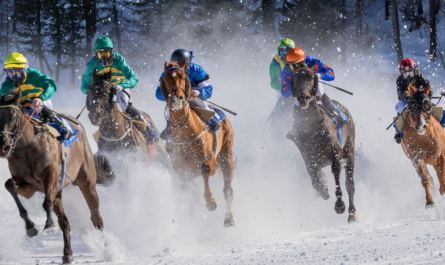
Skijöring—being pulled on skis by an animal or vehicle—originated as a practical winter travel method. Over time, it evolved into a sport that blended endurance, coordination, and speed.
Frozen lakes provided perfect venues: wide, flat, and predictable. Early skijöring races featured horses, then motorcycles, and eventually cars pulling skiers around marked courses.
A Spectacle for Winter Festivals
By the mid-20th century, skijöring events became highlights of alpine winter festivals. They combined athleticism with theatrical flair, drawing crowds who enjoyed the mix of danger, skill, and celebration.
Skijöring’s inclusion in frozen-lake racing culture demonstrated how ice events could merge sport with community entertainment.
Frozen Lakes as Grand Prix Arenas
As motorsport grew more organized, frozen lakes hosted increasingly sophisticated events.
Temporary Circuits on Natural Ice
Organizers carved tracks directly into ice surfaces, marking turns with snowbanks or wooden stakes. These circuits tested drivers’ ability to handle constant oversteer and minimal grip—skills rarely required in conventional racing.
Unlike permanent tracks, ice circuits changed daily based on temperature, wind, and snowfall. This unpredictability added a strategic layer, rewarding adaptability over rigid planning.
International Competition and Prestige
By the 1930s and 1940s, winter races on frozen lakes attracted international participants. Some events were seen as off-season training; others carried prestige comparable to summer races.
For racers, success on ice signaled exceptional control and courage—qualities admired across motorsport disciplines.
Engineering Advances Driven by Ice Racing
Frozen-lake racing played an important role in automotive innovation.
Studded Tires and Traction Science
Experiments with tire studs directly influenced winter-driving technology. Lessons learned from racing helped manufacturers refine stud patterns, rubber compounds, and tread designs for consumer vehicles.
Suspension and Weight Distribution
Ice racing revealed how subtle changes in weight balance could dramatically affect handling. Engineers used these insights to improve suspension geometry and vehicle stability systems.
In this way, frozen-lake racing quietly contributed to advancements that benefit everyday drivers in cold climates.
Modern Ice Racing and Speed Records
While some early events faded, frozen-lake racing never disappeared.
High-Speed Runs in the Modern Era
Today, frozen lakes are used for controlled speed attempts and manufacturer testing. Vehicles equipped with advanced traction systems and precision-engineered tires push the limits of what is possible on ice.
Modern events emphasize safety planning, ice measurement, and environmental responsibility—reflecting both technological progress and heightened awareness of risk.
Recreational Ice Racing Communities
In places like Scandinavia, Canada, and parts of the United States, amateur ice racing thrives. Enthusiasts modify everyday cars to race on frozen lakes, creating grassroots communities that celebrate skill, ingenuity, and winter resilience.
Risks and Respect for Nature
Despite its allure, racing on frozen lakes carries inherent danger.
Ice Thickness and Structural Integrity
Safe racing requires careful monitoring of ice thickness and consistency. Temperature changes, currents, and pressure cracks can weaken ice unexpectedly.
Modern organizers employ drilling, sonar, and visual inspections to reduce risk—but uncertainty can never be fully eliminated.
Environmental Responsibility
Ice racing communities increasingly emphasize leaving minimal impact. Temporary markings, removable barriers, and strict cleanup protocols help protect fragile winter ecosystems.
This balance between sport and stewardship is essential for the tradition’s survival.
Why Frozen-Lake Racing Endures
Racing on frozen lakes continues not because it is easy—but because it is difficult.
A Test of Human Adaptability
Ice forces racers to abandon brute force in favor of finesse. Every turn demands attention; every mistake is amplified. This purity of challenge appeals to those who value mastery over machinery.
A Celebration of Winter Culture
In cold regions, frozen-lake racing transforms winter from an obstacle into an asset. It turns harsh conditions into communal celebration, blending sport, history, and seasonal identity.
Conclusion: Ice as a Living Racecourse
The history of racing on a frozen lake is a story of adaptation—of humans learning not to fight winter, but to race with it. From early speed experiments to motorcycle championships, skijöring spectacles, and modern performance testing, frozen lakes have proven themselves as dynamic, meaningful arenas.
More than a footnote in motorsport history, frozen-lake racing reflects humanity’s enduring desire to explore limits—even when the ground beneath those limits is ice.